
Context
In many studies, automation is presented as the new Holy Grail to boost productivity, via methods such as Scan-to-BIM, 3D printing, etc. However, construction professionals tend to be cautious when it comes to changing their work habits, as they are obsessed with risk and cost management. In this context, the aim of this article is to see, on a specific case, how automation can help construction professionals to perform quantity surveying.
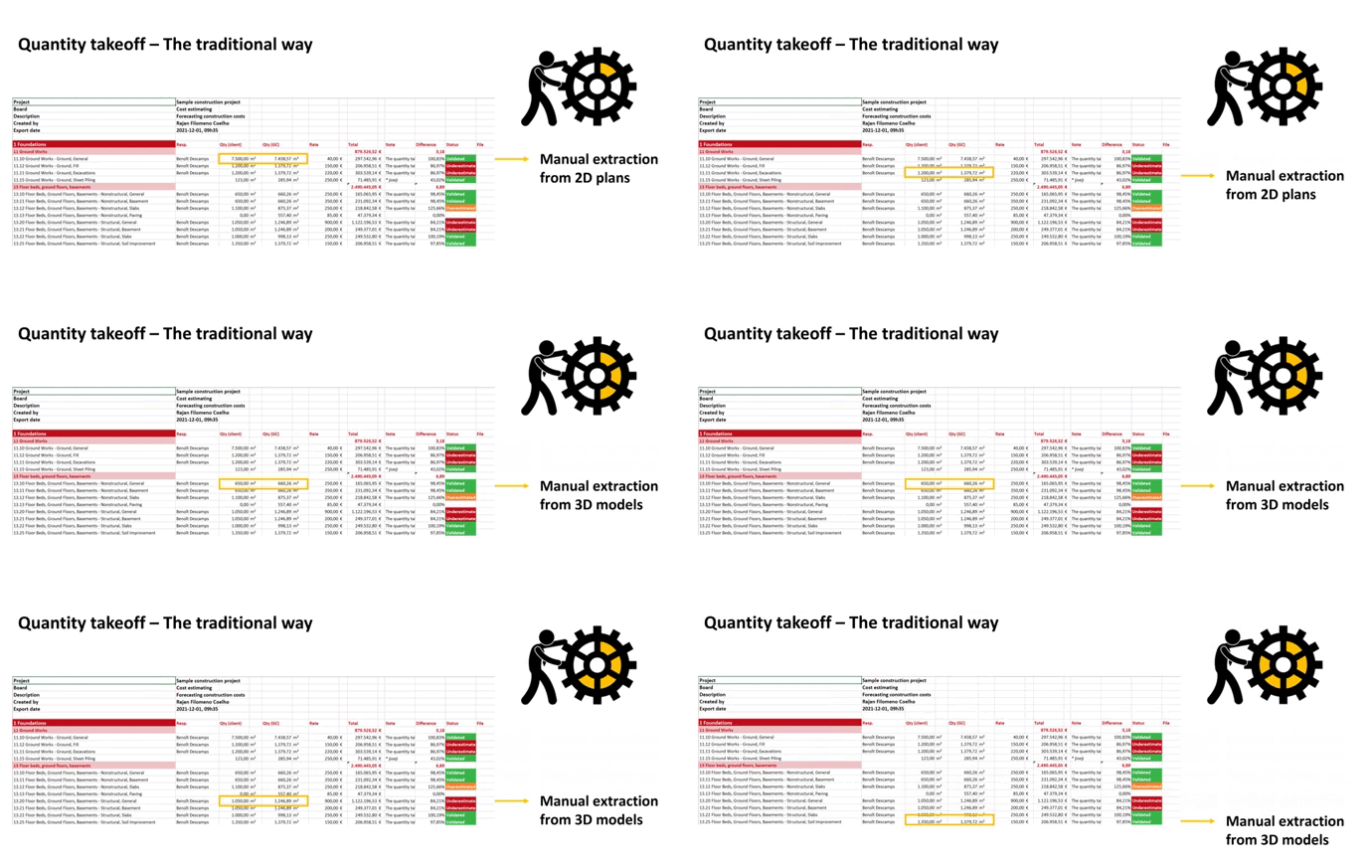
Quantity surveys are essential in the preliminary phases of construction projects for both owners and general contractors for cost control purposes. These calculations are still often done manually. A first step towards automation can be made by using BIM (Building Information Modelling) technology. In short, the BIM model is a virtual twin of the building, with a database containing the geometry and all the properties of the objects (materials, classification codes, physical characteristics, phasing, etc.).
However, even today, the quantities exported from these 3D models are not always reliable (e.g. holes are not correctly taken into account in the volume calculation, disconnected surfaces cause errors, etc.). In this context, the question of the trust that can be placed in any automation process is legitimate. Unlike a black box, the software user – whether a BIM expert or not – should be able to quickly and manually check the results obtained by the automation process. Let’s see how to do this.
A practical application: automate quantity reports
The discussion will be based on Kabandy, a build quantity management software available online. From BIM files (downloaded in Revit or IFC format), a viewer allows to explore the 3D model, browse its properties, take measurements, etc. In addition, dynamic tables (also known as boards) can be designed to establish a quantity survey or cost estimate, just like an Excel spreadsheet, but with the ability to share them easily with colleagues or other project stakeholders.
However, for hundreds or even thousands of lines in the survey, extracting quantities manually can still be very tedious, especially when the process has to be repeated each time a new version of the BIM model becomes available. To alleviate this burden, the process can be fully automated in Kabandy. In a few words, the workflow consists of providing:
- An excel survey template describing the content of the planned survey, together with additional data on automation rules. In particular, filters should be defined for each row to match objects to the corresponding quantity. This can be done by means of a property (or combination of properties) encoded in the BIM model, such as classification code, Revit family or any other relevant parameter;
- A BIM model. Note that for larger projects, it may be composed of several IFC or Revit files, corresponding to several areas of the building, or various disciplines (architecture, structure, HVAC, MEP, etc.).

Behind the scenes, the automation process runs on dedicated cloud servers to calculate quantities from 3D geometries (via three.js technology combined with internal algorithms), and build measurements that can be accessed online. In the example shown in the figure, the table was generated in less than 10 minutes and contains 860 lines with 1720 measurements and associated 3D views.
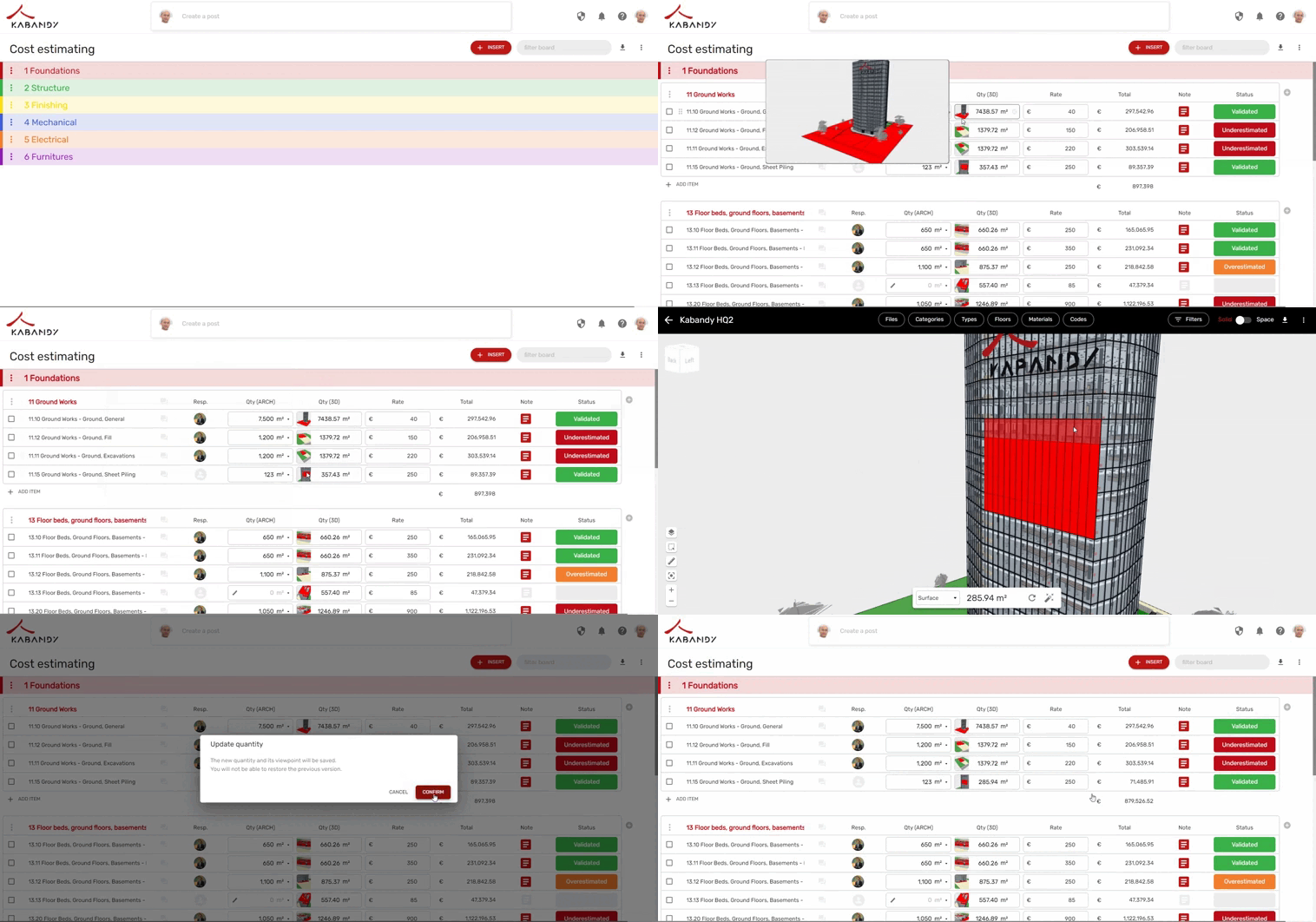
An innovative aspect of these dynamic tables is their <b>inherent integration with the 3D model</b>. Indeed, each quantity can be directly accessed and verified in the viewer. For example, the exact areas used to estimate the total area needed to form a slab can be viewed. This two-faced statement (numerical and visual) helps ensure confidence in the results obtained.
Perfection is not of this world, so what if a specific quantity needs to be corrected or updated? Thanks to the link to the BIM model, a manual check and update is possible, always leaving the final say to the devisor.
Conclusions
As we have shown here, when used correctly, automation not only saves time by avoiding repetitive and tedious operations, but also reduces the risk of error and increases confidence in the results. In other words, automation alone will never succeed without the expertise of construction professionals.
About the author
Rajan Filomeno Coelho, a civil engineer and PhD in Applied Sciences, is co-founder of Kabandy. As CTO of Kabandy, he is responsible for product development and university relations. His R&D interests range from BIM (Building Information Modelling) to numerical methods, especially optimization, operations research and machine learning.